
Discover how the new partnership between Martineau & Company and Peerless Products is set to...

Macro shifts in rates, volatility, and global flows are shaping which projects get funded and built in the Northeast. Macro insights based in part on Hedgeye’s Weekly Macro process; interpretation and construction lens by Martineau & Co.
Hedgeye’s latest Weekly Macro look is a reminder that we’re in a tricky, late‑cycle environment. For firms planning, bidding, or financing major projects in the Northeast—especially New York City—these shifts matter.
Below is a quick translation from “macro‑speak” into “jobsite impact.”
1. Rates: “Lower for Longer” Supports Funding, But Signals Late Cycle
Hedgeye’s read is unchanged: Bond yields = lower.
- 2s/10s/30s are Bearish on both TRADE and TREND.
- Treasury volatility (the “fractal” of a full cycle move) is dampening as markets front‑run the Fed toward easier policy.
Construction Angle
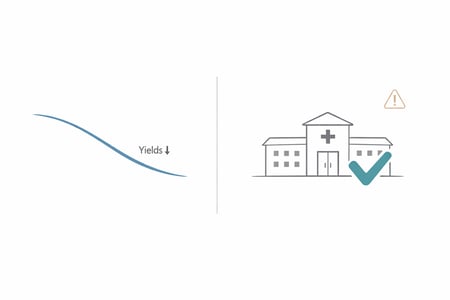 Lower yields help schools, healthcare, and infrastructure pencil out—but in a late‑cycle environment, lenders still tighten credit. Macro view by Hedgeye; construction lens by Martineau & Co.
-
Financing big jobs gets easier on paper. Lower yields generally mean cheaper debt for owners, developers, and public issuers (munis, authorities, school districts).
- But “lower for longer” is not an “all clear.” Late‑cycle easing often coincides with rising credit risk and tighter lending standards. Expect more questions from lenders and underwriters on lease‑up, covenant protection, and cost escalation—particularly on speculative office, hospitality, and luxury residential in NYC.
- Public work may accelerate. States and authorities can lock in long‑duration funding at attractive coupons—supportive for K–12, higher‑ed, healthcare, and infrastructure pipelines across the Northeast.
2. Volatility: VIX Turns Bullish TREND – Choppier Equities, Tighter Risk Budgets
The VIX flipped to Bullish TREND, and realized volatility remains elevated. Dealers are in negative gamma, which means markets can move fast in either direction.
Construction Angle

Higher volatility and tighter risk budgets mean more scrutiny on ROIC and more discipline around speculative towers. Volatility and positioning themes drawn from Hedgeye’s macro framework; sector and project lens by Martineau & Co
- Corporate capex gets more selective. With equity investors rewarding cash flow and penalizing missteps, Fortune‑500 tenants and REITs will scrutinize ROIC on every new building or major renovation.
- Long‑lead mega projects face higher hurdle rates. In NYC, that means more discipline around speculative office towers, big mixed‑use complexes, and luxury condos. Expect value‑engineering, phased construction, and more focus on flexible, adaptive spaces.
- For trades and suppliers, backlog quality > headline volume. Owners may cancel or re‑sequence marginal projects quickly; the strongest, best‑financed work will move forward.
3. Commodities & Quad 3: Sticky Energy & Metals – Cost Risk Is Back
The model nowcasts Quad 3 (growth slowing, inflation accelerating) for March:
- Oil remains Bullish TRADE and TREND; Brent up +2.7% WoW.
- Silver, platinum, gold, and copper all moved higher.
Construction Angle
- Budget pressure on materials. Persistent strength in energy and metals is a warning on input costs—glass, aluminum, steel, mechanicals, and transportation.
- Contract structure matters. Lump‑sum, long‑duration work with light escalation protection is increasingly risky for GCs and subs. Expect more owners to accept indexed or shared‑risk formulas, especially on structural steel, façade packages, and building systems.
- Specification discipline rises. Higher materials prices shift attention toward systems that lower lifecycle operating cost—energy‑efficient envelopes, high‑performance glass, and durable components that reduce maintenance.
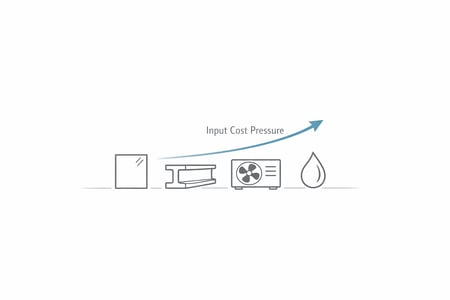
Quad 3—slowing growth with accelerating inflation—puts pressure on glass, metals, and energy‑intensive components, making contract structure and specification discipline more important. Macro regime language anchored in Hedgeye’s process; construction application by Martineau & Co.
4. Dollar & Global Flows: Neutral Dollar, Strong EM & Japan
The U.S. Dollar Index is Neutral TREND within its Risk Range. Hedgeye is expressing views through long Swiss franc and select EM equities; Japan, India, Mexico, and Turkey continue to lead.
Construction Angle

Global capital is still hunting yield and safety—tilting toward core‑plus, income‑producing assets over highly leveraged speculative towers. Macro view reflects themes from Hedgeye’s global flows work; local real‑estate implications by Martineau & Co.
- Imported components remain a swing factor. A neutral Dollar today doesn’t remove FX risk for curtainwall, specialty glass, hardware, or façade components sourced from Europe or Asia. Procurement teams should keep hedging and schedule buffers in place.
- Global capital is still hunting yield and safety. With parts of EM and Japan performing well, global investors continue to diversify. For NYC, that likely means:
- Continued foreign interest in core‑plus assets and stabilized, income‑producing buildings.
- Less appetite for highly leveraged, speculative towers with opaque leasing plans.
5. U.S. Equities: Narrow Leadership, Industrials Outperform
The last three months have been the worst stretch for SPX vs. equal‑weight SPX since 2001, even as the index sits near all‑time highs. Leadership is very narrow:
- Hedgeye is Long Industrials (XLI) – the standout at +6.4% MoM.
- They remain Short Consumer Discretionary (XLY), Tech (XLK), and Financials (XLF).
Construction Angle
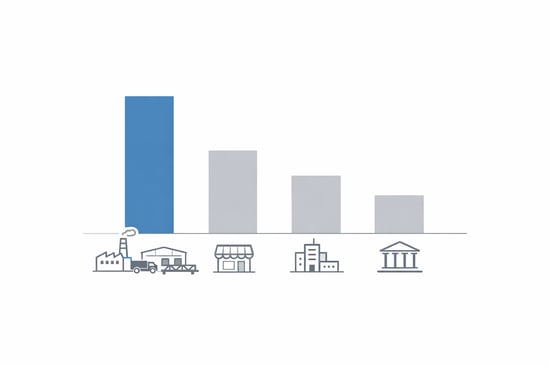 Narrow equity leadership favors Industrials and infrastructure‑linked themes over Consumer, Tech, and Financials—supportive for manufacturing, logistics, and modernization projects. Sector positioning rooted in Hedgeye’s macro views; Northeast construction read‑through by Martineau & Co.
- Industrials & infrastructure themes have support. Manufacturing, logistics, and infrastructure‑related projects across the Northeast should continue to see capital—plants, distribution centers, life‑science manufacturing, and modernization of existing facilities.
- Consumer‑facing and Tech office demand is more fragile. If Discretionary, Tech, and Financials underperform, expect more caution around:
- New flagship retail and experiential spaces.
- “Trophy” tech office build‑outs.
- Financial‑sector corporate campuses or consolidations.
- In NYC, that likely translates into renovation and repositioning over raw expansion—upgrading existing stock for flexibility, ESG performance, and life‑safety rather than adding as much net new square footage.
What This Means for Our Partners
Translating late‑cycle macro into jobsite reality: focus on must‑build work, be the partner that de‑risks façade and glass decisions, and align your pipeline with the macro backdrop.
At Martineau & Co, we sit at the intersection of macro shifts and jobsite reality. A few practical takeaways for our glaziers, fabricators, and design partners in the Northeast:
- Plan for rate‑driven opportunity. Lower yields can unlock public and institutional projects—schools, healthcare, higher‑ed, and civic work—where long‑duration glass and façade packages are central.
- Protect margins against Quad 3. Escalation clauses, procurement hedges, and early material commitments become more important as Energy and metals grind higher.
- Prioritize resilient segments. Industrial, infrastructure, healthcare, and education look relatively better positioned than speculative office or luxury residential.
- Design for durability, safety, and operating efficiency. In a world of tighter risk budgets and higher operating‑cost awareness, systems that improve fire‑safety, security, and energy performance (high‑performance glazing, fire‑rated systems, and security glass) gain strategic value.
Macro won’t tell you which beam goes where, but it does shape which projects actually get built, how they’re financed, and where owners are willing to spend for performance instead of just lowest first cost.
For Martineau & Co’s network in New York and across the Northeast, that means three things:
- Your best opportunities will be in “must‑build” work. Public, institutional, industrial, and infrastructure projects tied to long‑term policy, mission‑critical operations, or safety are far more likely to proceed than discretionary, prestige‑driven jobs. That’s where high‑performance envelope solutions, fire‑rated systems, and security glazing move from “nice to have” to “non‑negotiable.”
- The bar is rising on partners, not just products. In a late‑cycle, Quad 3 tape, owners and CMs want fewer surprises and more certainty. Teams that can help de‑risk façade and glass decisions—through earlier involvement, tighter coordination, and realistic lead‑time and cost guidance—will win and keep the best work.
- Macro‑aware planning is now a competitive edge. The firms that align their bid strategy, pipeline focus, and design choices with this backdrop will look smarter to lenders, underwriters, and end‑users—and will protect their own balance sheets in the process.
If you’d like to dig into what this means for a specific pursuit—whether it’s a school in Westchester, a healthcare expansion in Boston, or a complex mixed‑use project in Manhattan—we’re happy to walk through the macro, the materials, and the façade options with your team.
In the meantime, we’ll keep translating the weekly macro picture into clear, practical implications for Northeast construction—so you can focus on building the projects that still make sense when the cycle gets tricky.
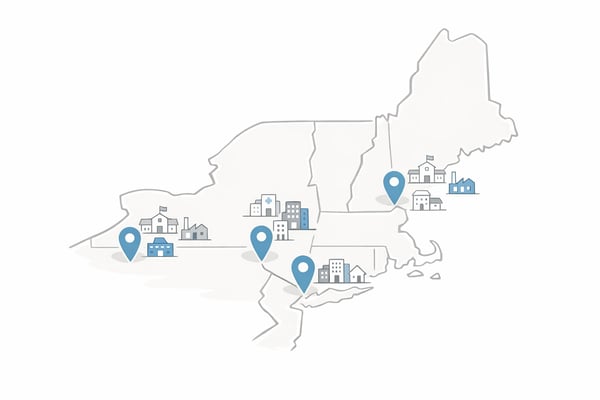
From Westchester schools to Boston healthcare expansions and complex mixed‑use work in Manhattan, Martineau & Co helps teams connect the macro picture to façade and glass decisions on the ground