
Flatter Glass, Better Facades: What Viracon’s New Millidiopter Specification Means for Your Projects
Architects spend countless hours refining elevations, aligning mullions, and tuning glass...

A coating may define part of the design intent. But it does not fully define the finished glass product that will be installed on the building.
When a glazing specification names a low-E coating and lists center-of-glass performance values, it can feel like the glass is well defined. In many cases, though, it is not.
The finished façade depends not only on the coating, but also on:
That distinction matters. The more clearly the specification defines the fabricated glass product, the better chance the project has of delivering the intended appearance, performance, durability, and long-term serviceability.
A recent glazing specification we reviewed did many things well. It addressed ASTM standards, delegated design, mockups, safety glazing, insulating glass warranties, thermal and optical targets, and a basis-of-design low-E coating.
Those are important fundamentals. But the specification remained largely coating-centered. It identified a coating family and basic IGU construction while leaving several fabrication-related factors unresolved. That is where teams can assume they have controlled more than they really have.
A coating specification helps establish:
That is valuable. But it still does not fully define:
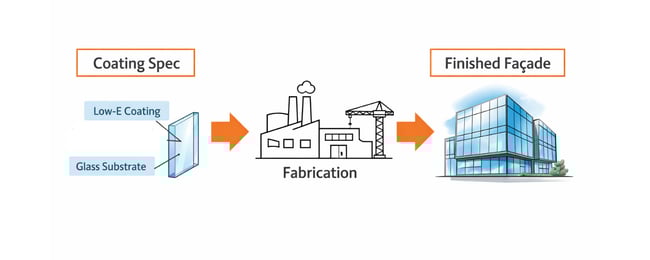 Why Fabrication Belongs in the Specification Conversation
The installed glass on the building is not a coating sample. It is a fabricated glass unit.
Two projects can specify the same coating and still end up with very different results because fabrication affects:
Those are not secondary issues. They directly affect whether the façade looks right, performs as expected, and remains supportable over time.
This is especially important on:
In these applications, subtle differences become much more noticeable once the wall is complete.
If you want a related look at single-source coordination, Why Viracon Is Different: Single‑Source Glass Fabrication for Your Northeast Projects is a useful companion article.
A stronger fabricated-glass specification does not have to be proprietary. It simply needs to define more of the finished product.
The reviewed spec required an insulating-glass manufacturer approved by the coated-glass manufacturer. A stronger version would also address the qualifications of the fabricator responsible for:
That matters because the same coating can still produce different visual and performance outcomes depending on who fabricates the glass.
The reviewed spec included general language about uniformity and roll-wave direction, but it did not clearly define expectations for:
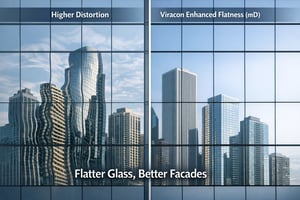
A façade can be technically acceptable and still look wrong.
For a deeper discussion, see Flatter Glass, Better Facades: What Viracon’s New Millidiopter Specification Means for Your Projects.
The reviewed spec allowed an aluminum spacer and air-filled units. In a Northeast climate, stronger language around spacer system and IGU construction can better support:
Spacer choice is not a minor detail. It affects the edge of the unit where many real-world performance issues show up.
For more on that topic, see Warmer Edges, Better Facades: How Viracon VTS® Spacer Supports Big Glass Performance.
The specification required mockups to demonstrate aesthetic effects, but it did not clearly define what the team should evaluate.
A stronger mockup requirement would call for review of:
That makes the mockup more useful as a decision tool rather than just a procedural step.
Warranties matter, but so does traceability. Future replacement quality depends on knowing how the original glass was built.
That is where Meet the Viracon Identification Number (VIN): Architects & Glaziers’ Tool becomes especially helpful. VIN supports future replacement accuracy by helping owners and glaziers identify and replace damaged glass with an exact match.
A better specification improves the odds of achieving:
It cannot guarantee a perfect result. But it can reduce ambiguity and improve the quality of the finished product that ends up in the wall.
That is also one reason single-source coordination can matter. When more of the finished unit and fabrication process is controlled by one source, teams can reduce gray areas around responsibility, coordination, and long-term support.
A coating is important, but it is only one part of what the owner ultimately sees and pays for.
If the specification defines only the coating, it leaves too much of the final result to chance. If it defines the finished fabricated glass more completely, it gives the project a much better chance of delivering the intended appearance, performance, and durability.
If your team wants to compare a coating-based specification to a more complete fabricated-glass approach, Martineau & Co can help review glazing language for appearance, thermal performance, and long-term project quality.
Architects spend countless hours refining elevations, aligning mullions, and tuning glass...

3151 Market Street Philadelphia PA
